The 2026 Azure Data Job Market
Analysis of 189 Azure data job postings collected in October 2026, including how the Azure, Fabric, and Databricks job markets overlap
Published 2026-10-17 · Muneeb
Executive Summary
-
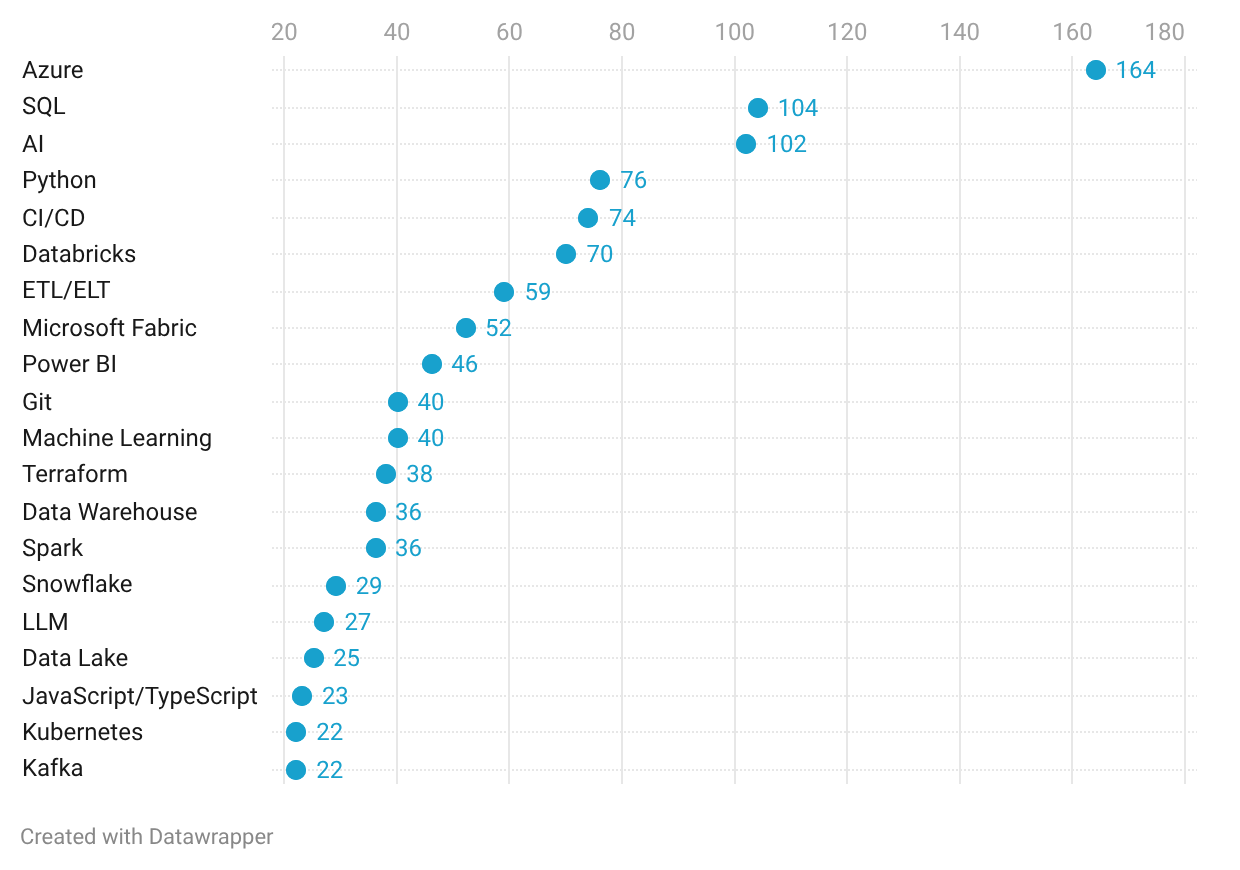
SQL is not going anywhere. 55% of Azure data jobs require SQL — more than Python (40%), and AI. SQL remains the most universal data skill in the market.
-
One in four Azure jobs mentions Microsoft Fabric. Fabric appears in 52 of 189 Azure postings (27.5%). Adopting Azure data platforms increasingly means adopting Fabric.
-
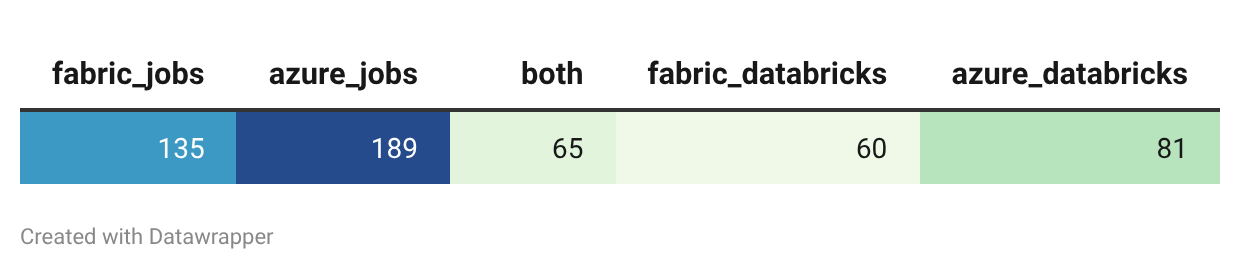
The Azure–Fabric–Databricks markets overlap heavily. 65 jobs appear in both Azure and Fabric datasets. 81 appear in both Azure and Databricks. These are not three separate markets — they are three layers of the same market.
-
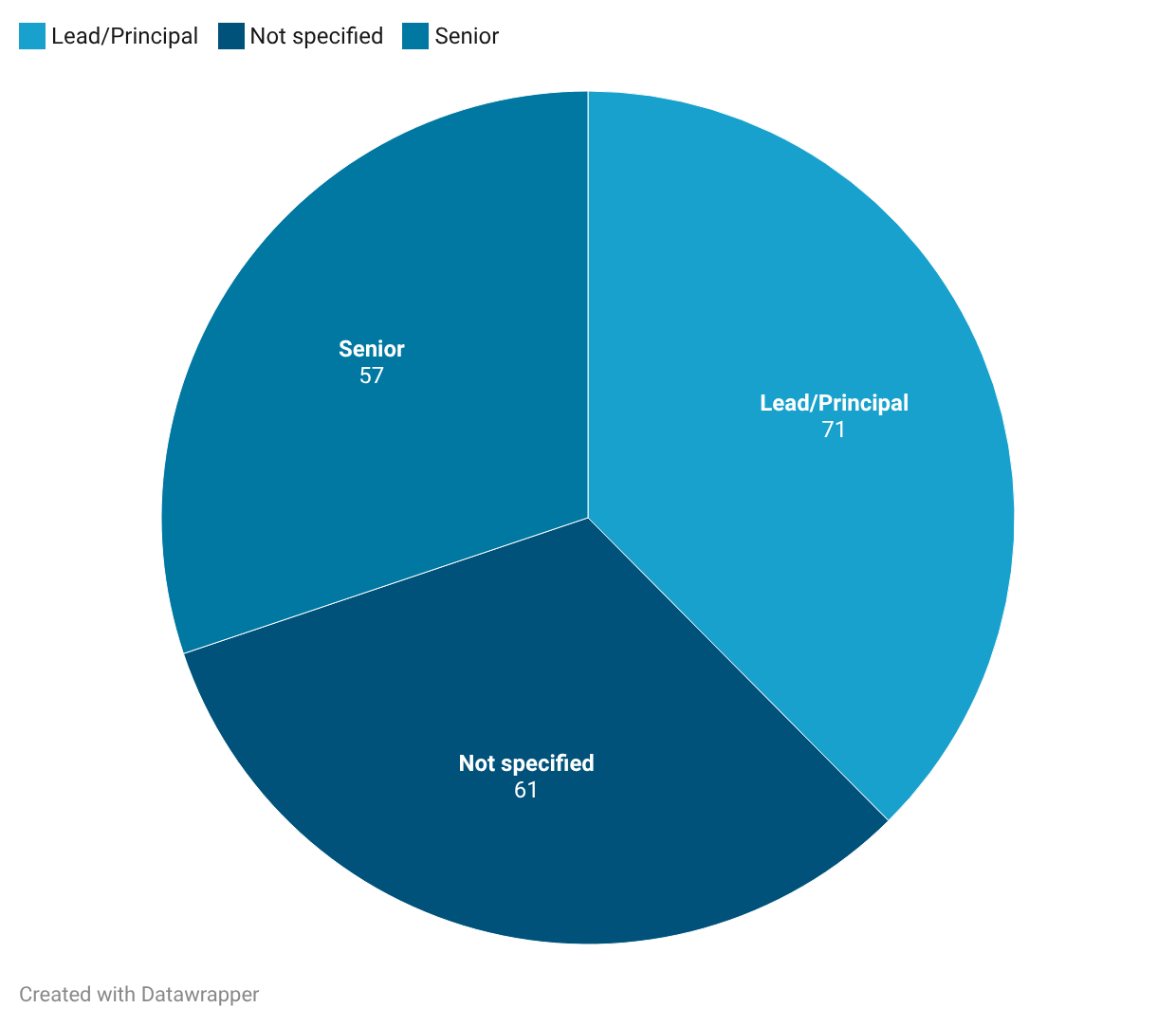
Azure data roles are mid-senior, not junior. 68% of Azure jobs target Senior, Lead, or Principal levels. Only a tiny fraction are possibly entry-level.
Key Findings
1. SQL outranks Python in Azure data roles
Finding: 63% of Azure data jobs mention SQL. 46% mention Python. 45% mention CI/CD.
Analysis: Python is often assumed to be the "modern data" language. But in Azure data roles, SQL still leads by a wide margin. This reflects the nature of Azure data work: ETL, warehouse modeling, query optimization — all SQL-heavy tasks.
Python's presence at 46% is meaningful, but it's usually used for scripting, orchestration, or data science integration.
For job seekers: SQL fluency is non-negotiable. Python is a strong multiplier but not the entry requirement.
2. AI is surprisingly in high demand
Finding: A huge 62% of Azure data jobs mention AI.
Analysis: AI is often assumed to be a separate specialization. But in Azure data roles, 62% of postings mention it — making AI a mainstream expectation, not a niche skill.
This reflects the direction of Azure data work: preparing data for AI models, integrating Azure OpenAI and Copilot, and supporting ML pipelines directly from the data layer.
AI's presence at 62% is striking, but it is usually framed as an add-on to core data engineering — not a replacement for it.
For job seekers: AI literacy is becoming table stakes. You don't need to be an ML engineer, but you do need to understand how data feeds AI systems.
3. One in four Azure jobs mentions Microsoft Fabric
Finding: 27.5% of Azure data jobs (52 of 189) mention Microsoft Fabric.
Analysis: Fabric is only three years old and it already appears in more than a quarter of Azure data jobs. This is adoption at enterprise speed.
The pattern is consistent with Fabric's positioning: it's not a replacement for Azure data tools, it's a new layer on top of them. Companies adopting Fabric are usually already invested in Azure Data Factory, Synapse, and Power BI. It seems like they're not switching but rather stacking.
For job seekers: If you work in Azure data, Fabric familiarity is no longer optional. Within 12 months, expect this number to exceed 40%.
4. Data engineering
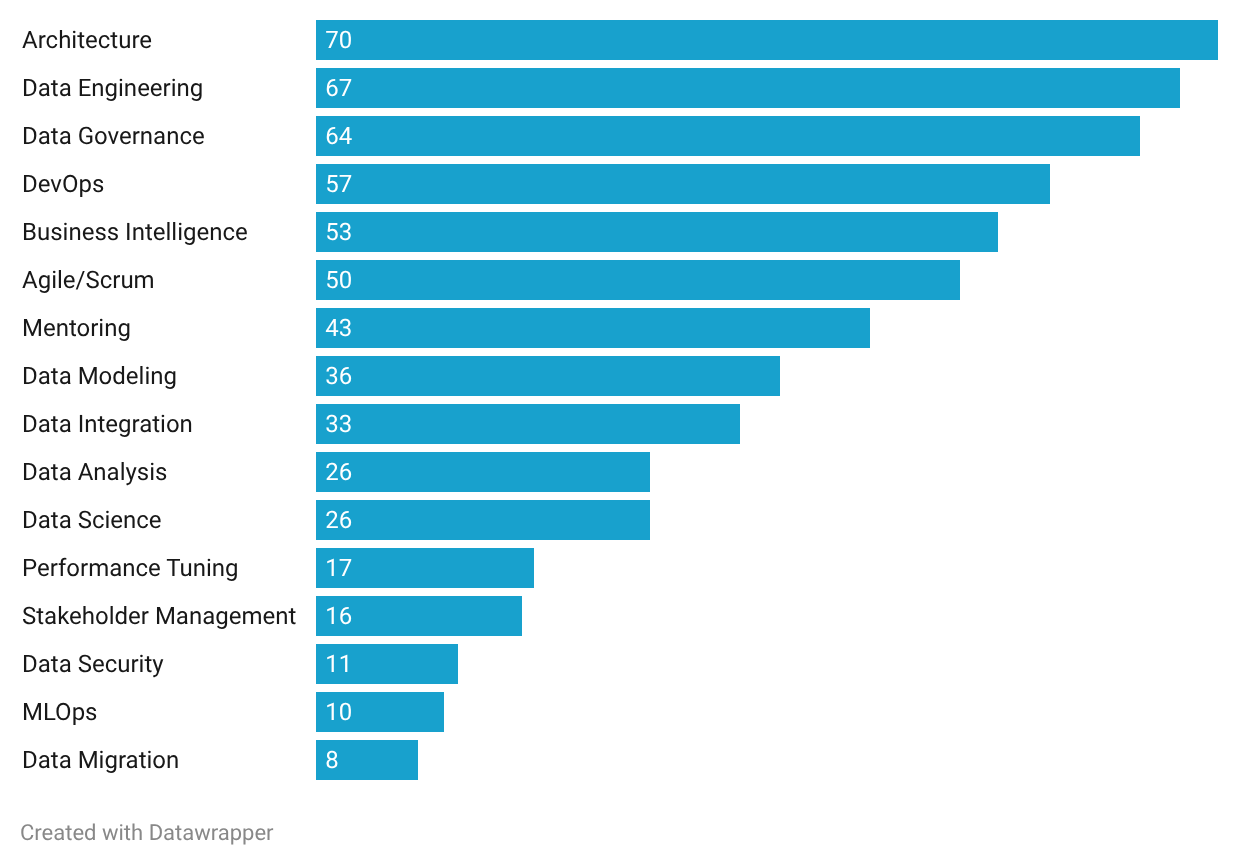
Finding: Architecture and Data Engineering are the two most in-demand skills in Azure cloud
Analysis: Employers are not just hiring for execution — they are hiring for design. Architecture ranking above Data Engineering signals that companies want professionals who can plan, structure, and govern data systems, not just build pipelines.
For job seekers: Hands-on pipeline skills get you in the door, but architecture thinking is what move you into senior and lead roles.
5. The Azure, Fabric, and Databricks markets overlap heavily
Finding: Of the combined dataset:
- 65 jobs appear in both the Azure and Fabric datasets
- 60 jobs appear in both Fabric and Databricks
- 81 jobs appear in both Azure and Databricks
Analysis: This is the most important finding in this report.
The story the industry tells is one of platform competition — Fabric vs Databricks, Azure vs AWS vs GCP. The story the job market tells is different. Employers are not hiring "Fabric people" or "Databricks people." They are hiring "data people who can work across these platforms."
Nearly half of all Fabric jobs collected also mention Azure data tools. More than a third also mention Databricks. This is not a market of exclusive choices — it is a market of integration.
For job seekers: The safest bet is not to specialize on one platform. Learn the underlying concepts — data modeling, ETL, governance, cost optimization — and apply them across whatever stack the employer happens to use.
6. Azure data roles target experienced engineers
Finding: Majority of Azure data jobs target Senior, Lead, or Principal levels.
Analysis: This mirrors what I saw in the Fabric job market. Azure data engineering is not an entry-level field. Companies are looking for people who have shipped data pipelines, managed production systems, and can architect solutions without supervision.
The distribution (37.6% Lead/Principal, 30.2% Senior, 32.3% not specified) suggests that "entry-level Azure data engineer" is essentially a non-existent title. New entrants most likely come from adjacent roles (BI developer, SQL analyst, backend developer) and transition in.
7. Salary
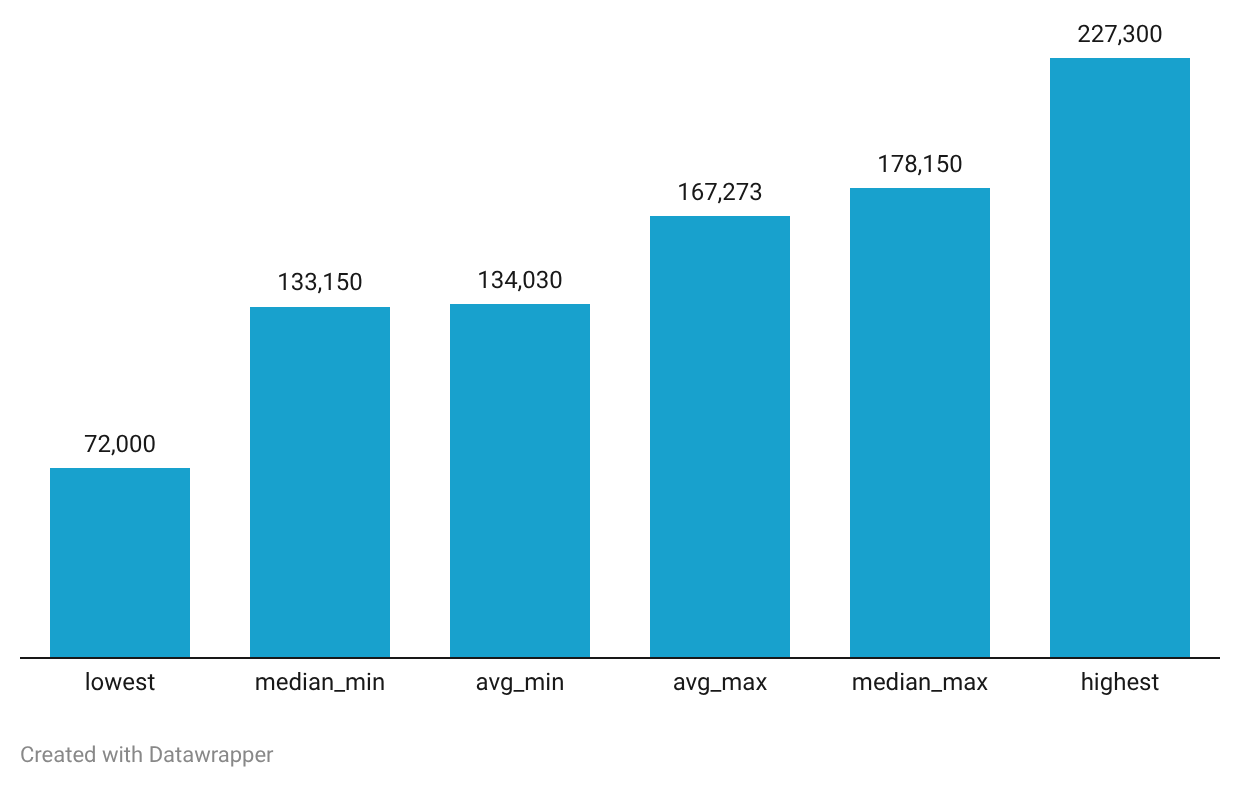
Finding: Azure data salaries range from a low of $72,000 to a high of $227,300, with a median minimum of $133,150 and a median maximum of $178,150.
Analysis: The spread tells the real story. The gap between the lowest posting ($72,000) and the median minimum ($133,150) is enormous — nearly $61,000. This suggests the market is not one market but two: junior or entry-level roles pulling the floor down, and senior/architect roles setting the ceiling.
The averages sit close to the medians (average minimum $134,030 vs. median minimum $133,150; average maximum $167,273 vs. median maximum $178,150), which means the data is not skewed by a few outliers. The distribution is relatively healthy.
8. Azure data jobs are mostly on-site or hybrid
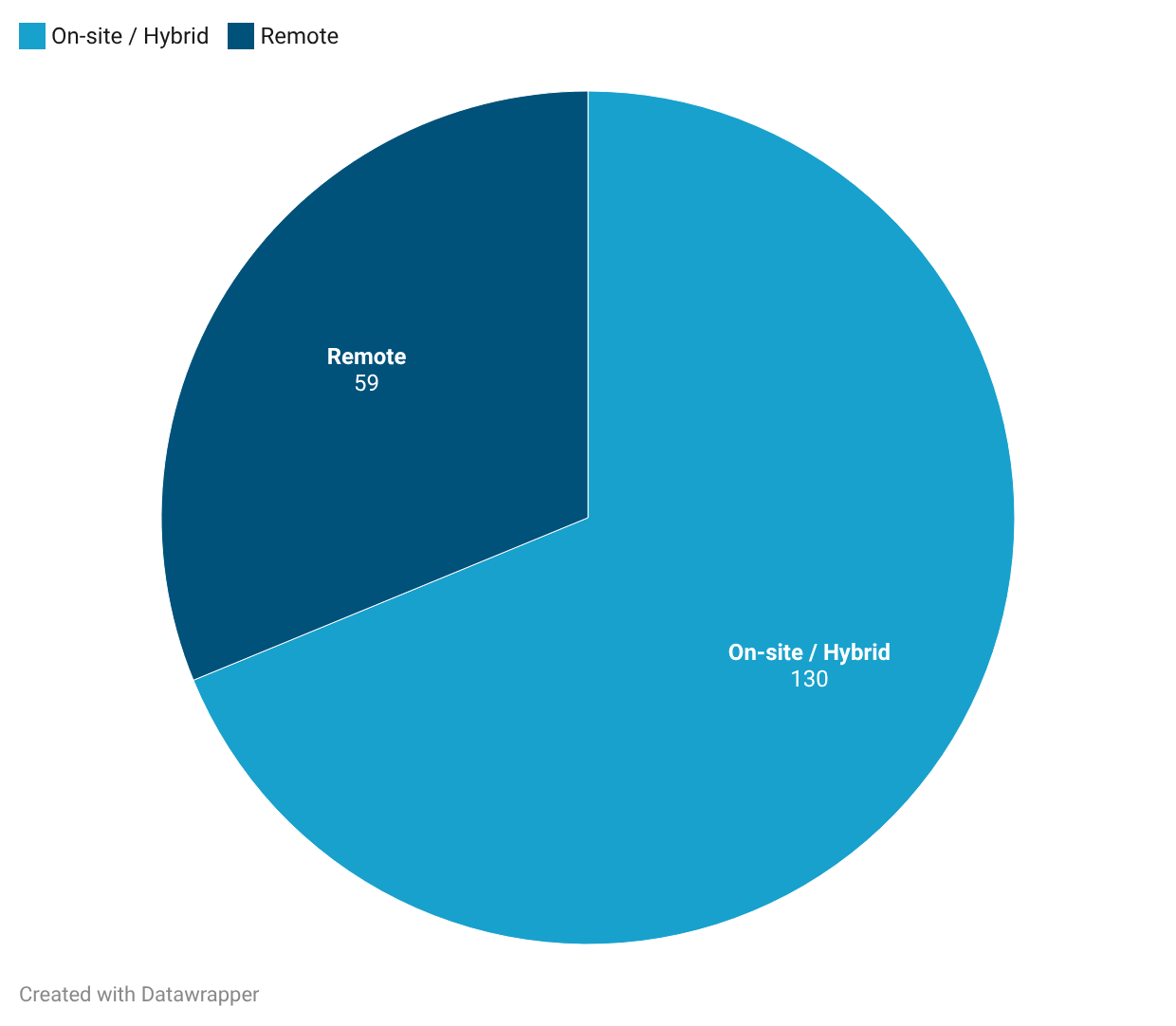
Finding: Only 31.2% of Azure data jobs are fully remote. 68.8% are on-site or hybrid.
Analysis: This is nearly identical to the Fabric market (32.7% remote) research. The consistency suggests it's not a platform-specific artifact — it's a category-level pattern. Data engineering, at least in the enterprise segment that Azure targets, has become a hybrid-work profession.
Possible reasons: tight collaboration with business stakeholders, on-call responsibilities, and the industries adopting Azure (finance, government, healthcare) tending toward return-to-office policies.
Methodology
Data collection. I collected 189 Azure data job postings from three public ATS sources — Greenhouse, Lever, and Ashby — during October 2026. Each posting was matched against a keyword list specific to Azure data engineering roles (Azure Data Factory, Azure Synapse, Azure Databricks, Azure Data Lake, Azure Data Explorer, and related terms).
Enrichment. Each posting was parsed to extract:
- Technologies mentioned (Azure, SQL, Python, Fabric, Databricks, etc.)
- Skills (architecture, data modeling, governance, etc.)
- Seniority level
- Employment type
- Location
- Work type
Overlap analysis. Because a job can belong to more than one category, I tagged each posting with the topics it matched. A job mentioning both Azure and Fabric is counted in both — and appears in the overlap metrics.
Limitations
I publish this report because transparency matters more than hype.
Sample size. 189 postings is not the entire Azure data job market. It is a snapshot from three public ATS sources. Large enterprises and job boards I do not collect from are underrepresented.
Geographic bias. Half of the postings did not disclose a country. The data is skewed toward English-language postings and companies that use public ATS boards (typically tech and consulting firms).
Keyword-based extraction. Technology and skill mentions are extracted via keyword matching. Some false positives and false negatives are inevitable. The extraction is conservative — I would rather miss a match than invent one.
English-only. Postings in other languages are underrepresented by construction.
Data Access
The full dataset is available for download:
Download azure-jobs-2026-10.csv (189 rows)
Fields include: source, title, company, location, technologies, skills, experience level, and language.
You are free to use this data for research, journalism, or product development with attribution to TwinkleHaha.
TwinkleHaha collects job postings from public ATS boards weekly and publishes original research on cloud and data platform. All data is collected legally from public sources.
Get future reports by email
We publish original data research on cloud and data platforms. Subscribe to be notified when new reports drop.