The 2026 Microsoft Fabric Job Market
A first comprehensive analysis of 107 Microsoft Fabric job postings collected in October 2026.
Published 2026-10-11 · Muneeb
Executive Summary
-
Azure is the Bedrock: An overwhelming 85% of Fabric job postings also require Azure skills, indicating that Fabric is rarely a standalone skill but an extension of the broader Microsoft cloud ecosystem.
-
AI is Ubiquitous: 68% of roles mention AI, LLMs, or Machine Learning, signaling that Fabric engineers are increasingly expected to support AI-driven workloads.
-
Multi-Platform Reality: Nearly half (49.5%) of Fabric jobs also require Databricks skills, and 29% require Snowflake, proving that employers value cross-platform adaptability over vendor lock-in.
-
Seniority Bias: The market is not entry-level; 70% of roles target Senior, Lead, or Principal levels, with only 0.9% explicitly open to juniors.
-
Hybrid is the Norm: Remote work lags behind general tech trends, with only 32.7% of Fabric roles offered as fully remote.
Key Findings
1. Fabric jobs are Azure jobs
Finding: 85% of Fabric job postings also mention Azure.
Analysis: The data reveals that Microsoft Fabric is not being hired for in isolation. In 107 postings, Azure appeared in 91 of them (85%). This aligns with the architecture of Fabric, which is built on OneLake and deeply integrated with Azure Data Lake Storage, Azure Synapse, and Microsoft Entra ID.
For job seekers, this means that "Fabric-only" skills are insufficient. Employers are looking for professionals who understand the broader Azure data landscape. You cannot effectively manage a Fabric environment without a solid grasp of Azure resource groups, networking, and security protocols. This trend suggests that Fabric is viewed as the "SaaS layer" on top of a robust "PaaS/IaaS" foundation.
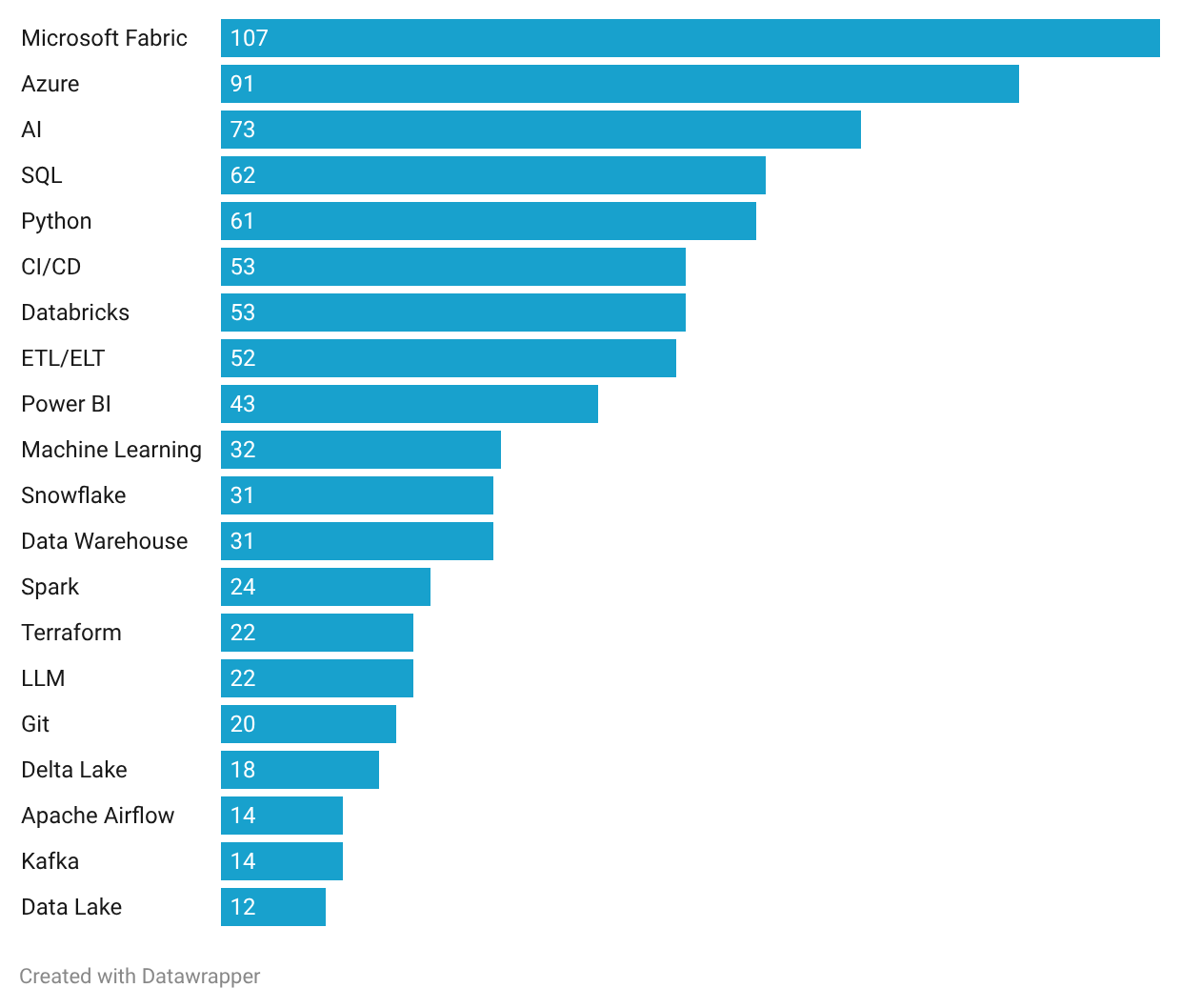
Caption: 85% of Fabric jobs required Azure while 68% required AI
2. Two-thirds of Fabric jobs involve AI
Finding: 68% of roles mention AI, LLMs, or Machine Learning.
Analysis: The convergence of Data and AI is no longer a future prediction; it is a current job requirement. 68.2% of the postings mentioned AI, with 20.6% specifically mentioning Large Language Models (LLMs) and 29.9% mentioning Machine Learning.
This indicates that Fabric is being positioned as a data source for AI models. Employers are not just looking for ETL developers; they are looking for engineers who can prepare data for Copilot integration, vector databases, and Azure OpenAI services. The high mention of Python (57%) alongside SQL (57.9%) further supports this, as Python is the primary language for AI and ML workflows.
3. Fabric engineers work in multi-platform environments
Finding: 49.5% mention Databricks, 29% mention Snowflake.
Analysis: Despite being a "unified" platform, Fabric is not replacing existing data stacks; it is being added to them. The data shows a massive overlap with Databricks (49.5%) and significant overlap with Snowflake (29%).
This suggests that companies are adopting a "best-of-breed" approach or are in the middle of migrations. They need engineers who can bridge the gap between legacy Snowflake warehouses and new Fabric implementations, or who can manage a hybrid environment where Databricks handles heavy engineering and Fabric handles BI and governance. "Competitor skills" are actually "complementary skills" in the eyes of hiring managers.
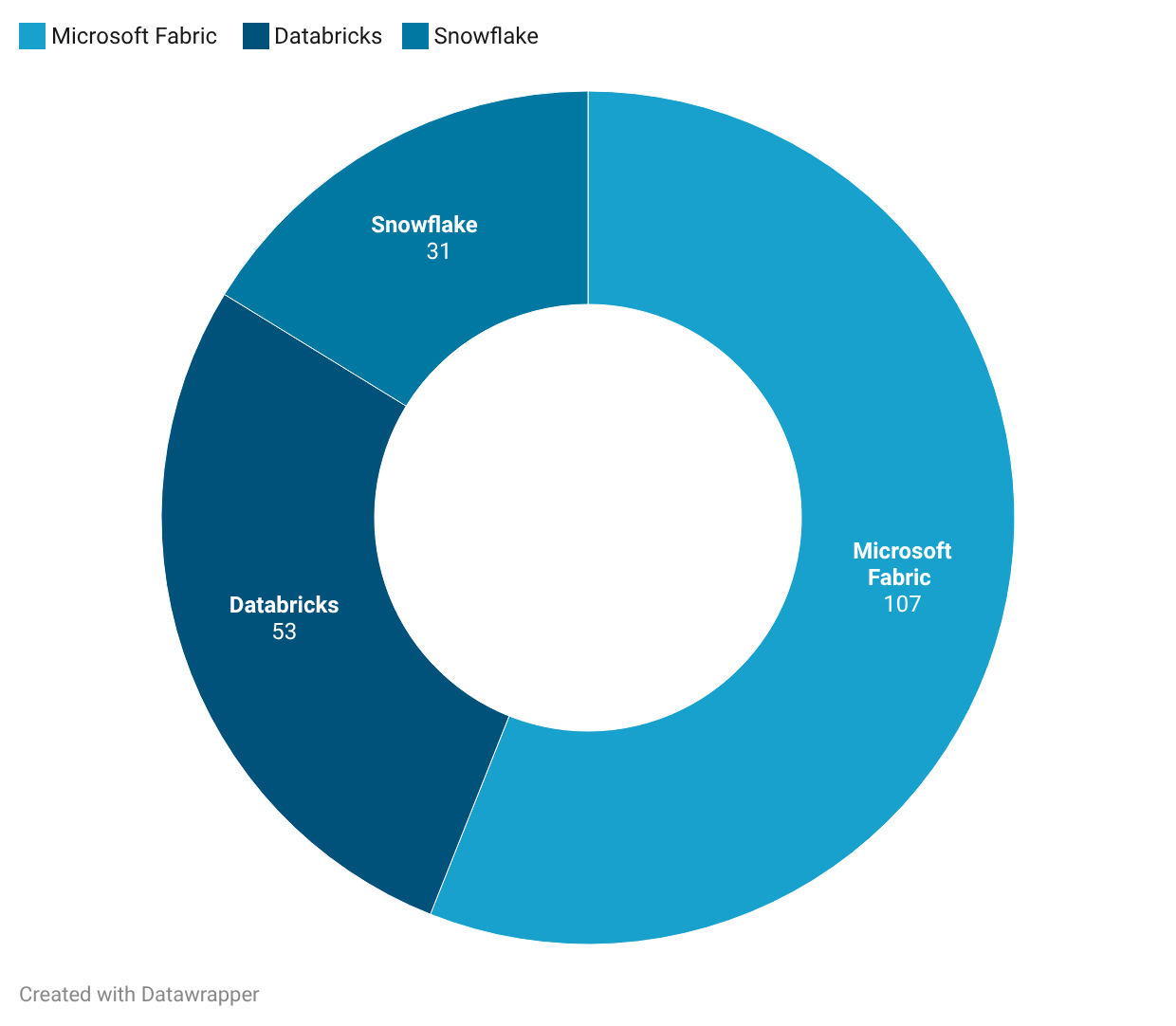 Caption: Databricks (49.5%) and Snowflake (29%) are the most common co-requisites.
4. Fabric is not an entry-level platform
Finding: 70% of roles target Senior, Lead, or Principal levels.
Analysis: The market for Fabric talent is heavily skewed toward experienced professionals. Senior roles account for 37.4%, and Lead/Principal roles account for 32.7%. Combined, this is over 70% of the market. In contrast, Junior roles represent less than 1% (0.9%).
This is likely due to the complexity of data architecture. Fabric requires knowledge of data modeling, governance, and CI/CD (mentioned in 49.5% of jobs). Employers are not willing to train juniors on these high-stakes architectural decisions. This creates a high barrier to entry for new graduates, but a high premium for experienced data engineers looking to upskill.
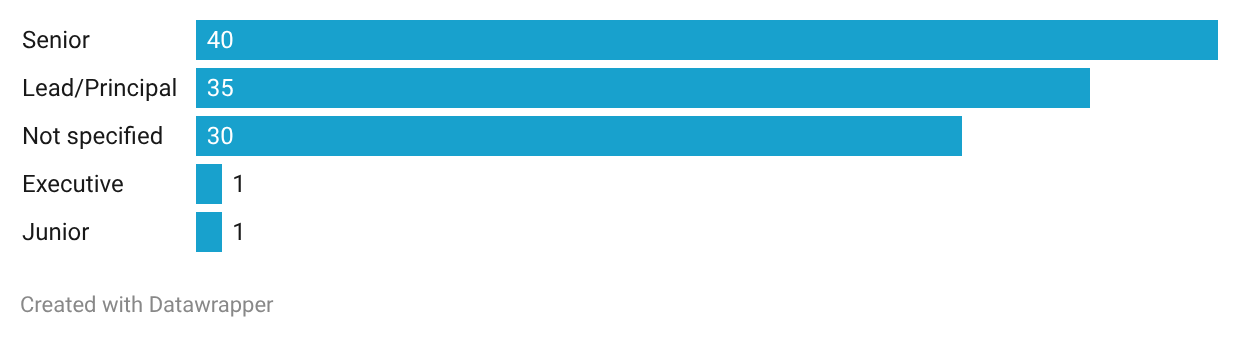 Caption: Senior (37.4%) and Lead/Principal (32.7%) dominate the market.
5. Salary ranges at most senior roles are $94k–$280k
Finding: Compensation reflects the seniority and strategic importance of the roles.
Analysis: Our data set of 16 salary-disclosed postings reveals a clear compensation band. For Senior and Lead/Principal roles, salaries range from $94,400 to $280,000 with a median of approximately $170,000.
The highest-paying roles—such as "Global Head of Sales Engineering" ($250k–$280k) and "Practice Director | AI Solutions" ($230k–$250k)—are strategic leadership positions. However, even hands-on technical roles command strong premiums: a "Senior Microsoft Fabric Architect and Consulting Lead" offers $150k–$180k, while a "Sr. Architect" offers $170k–$200k.
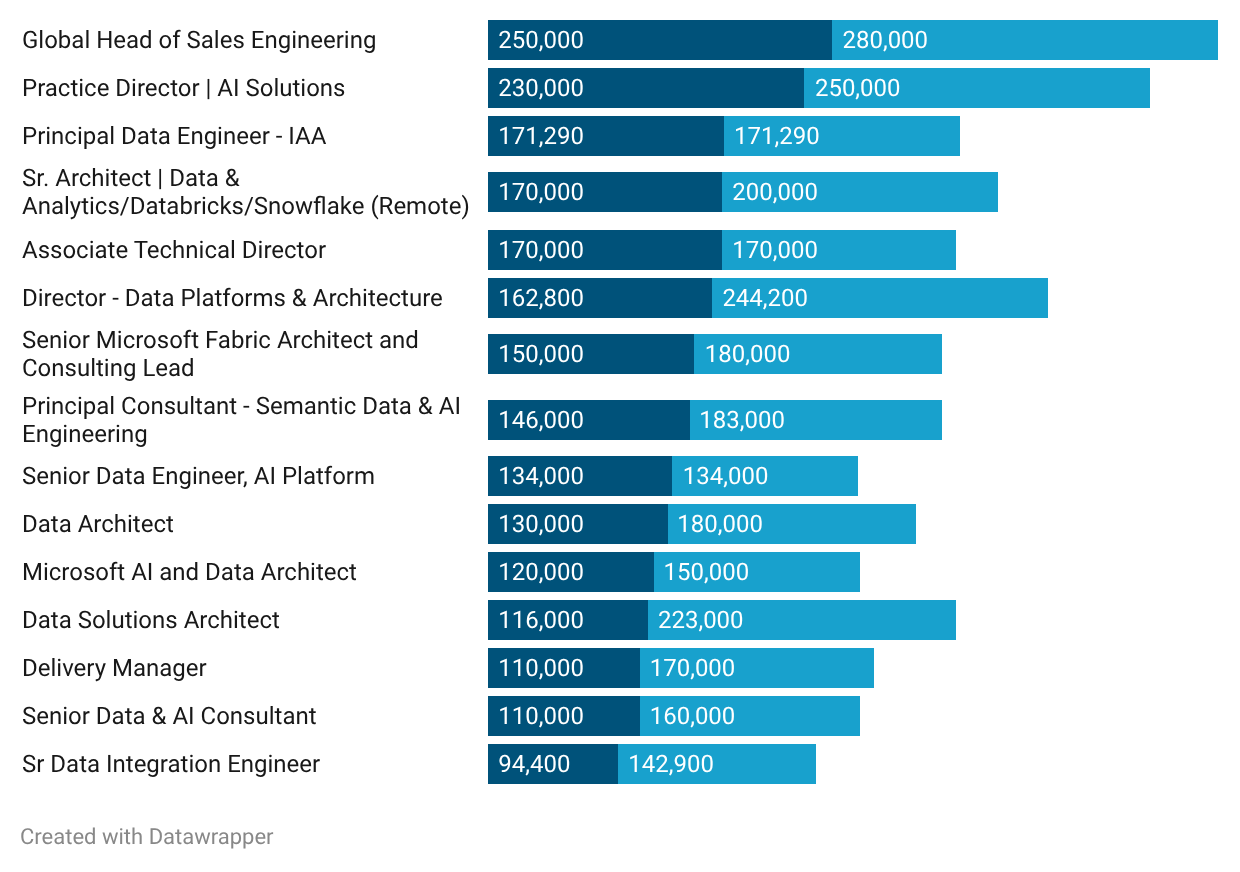 Caption: Salary ranges based on title
6. Remote work lags other cloud roles
Finding: Only 33% of roles are Remote.
Analysis: While the broader tech industry has embraced remote work, Fabric roles appear to be more conservative. 67.3% of jobs are On-site or Hybrid, while only 32.7% are fully Remote.
This may be due to the collaborative nature of data architecture and the need for close integration with business stakeholders. Alternatively, it could reflect the industries adopting Fabric (finance, healthcare, government) which tend to have stricter return-to-office policies. For job seekers, this means flexibility may be harder to negotiate in this specific niche compared to general software engineering.
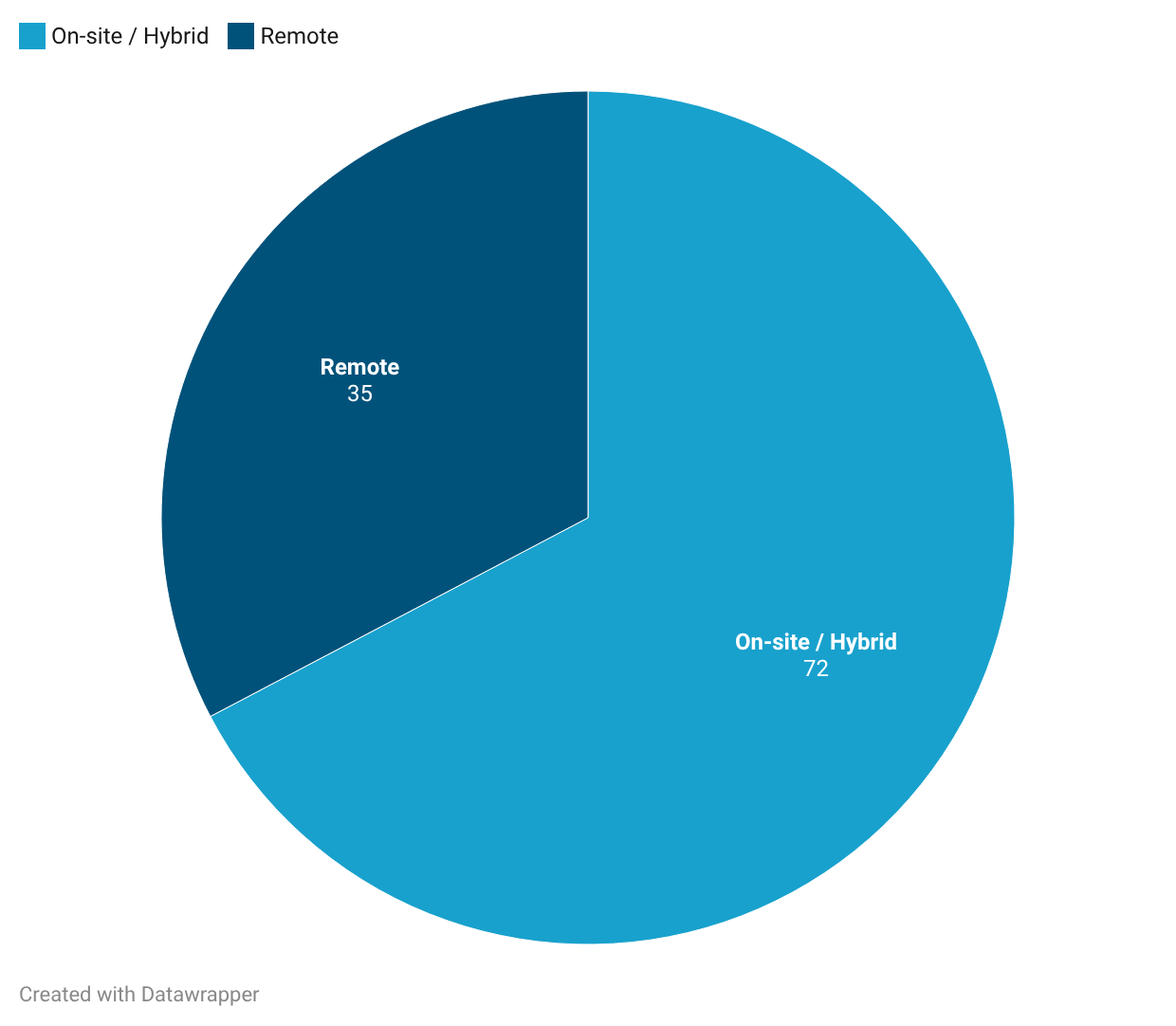 Caption: On-site/Hybrid (67.3%) vs. Remote (32.7%).
End of key findings. The sections below cover methodology, limitations, and data access.
Methodology
To ensure transparency and reproducibility, here is how this report was compiled:
Data Collection:
We collected 107 job postings from public ATS boards (Greenhouse, Lever, Ashby) via their public APIs and public job board endpoints during October 2026.
Cleaning:
Duplicates were removed. Postings were filtered to ensure "Microsoft Fabric" was a core requirement, not just a "nice to have."
Extraction:
We used a combination of regex and manual review to extract technologies, seniority levels, and work types.
Limitations of Extraction:
"AI" was counted if the posting mentioned AI, ML, LLM, or Copilot. "Senior" was counted if the title contained Senior, Sr., Lead, Principal, or Architect.
Limitations
We believe in honesty over hype. This report has several limitations:
Sample Size:
107 postings is a small sample. The market is larger, and this data may not represent the entire global market.
Salary Disclosure:
Only 16 of 107 postings (14.9%) disclosed salary. All other compensation references are absent from our dataset. We do not publish estimated salaries.
English-Only:
The search was conducted in English. Fabric jobs in non-English speaking countries are underrepresented.
Data Access
The dataset is available for download:
Download fabric-jobs-2026-10.csv (107 rows)
Fields include: source, title, company, location, technologies, skills, salary (where disclosed), experience level, and language.
Get future reports by email
We publish original data research on cloud and data platforms. Subscribe to be notified when new reports drop.